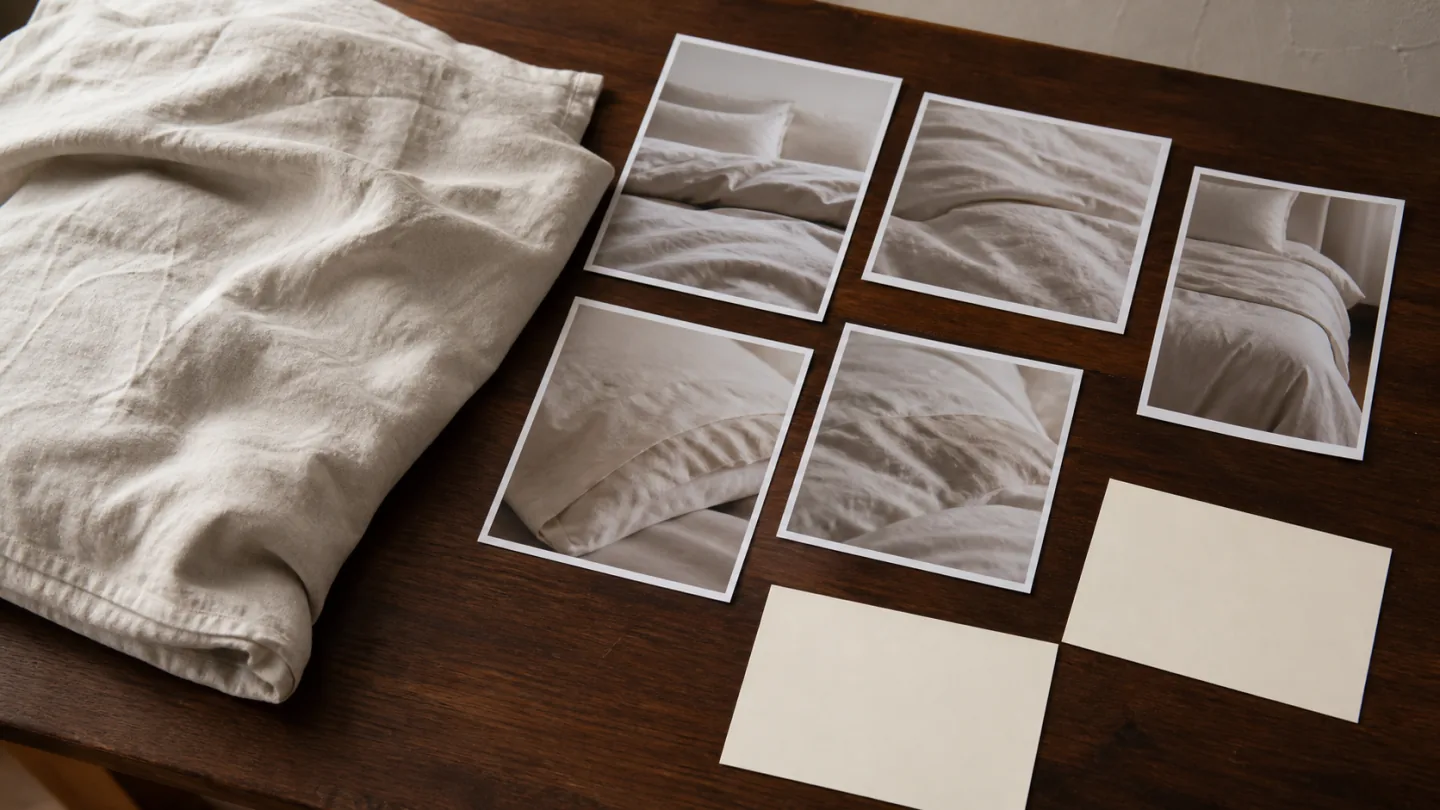
For international buyers sourcing textiles in Nantong or the Yangtze River Delta, a local photography partner can help prepare images while samples are still in China. Start with genuine work relevant to your products, then check resources, product understanding, sample handover, test-shot review and delivery scope.
This is a selection method, not a ranking or an endorsement of any provider. Confirm resources, dates, revisions and deliverables in writing for the actual samples and project.
Compare the work the project actually needs
A suitable team should explain what the buyer needs to see, where the images will appear and which decisions must be confirmed between sample receipt and delivery. Style, location and commercial terms matter, but do not replace these questions.
Use one comparison sheet for shortlisted studios so that attractive portfolios and persuasive introductions do not distract from differences in scope.
| Area | Evidence to request | Reason to ask further questions |
|---|---|---|
| Image provenance | Complete relevant projects and clear image disclosures | Only selected single images, or concepts mixed with client work |
| Product understanding | A plan for complete views, scenes, details and components | Style language without questions about fabric, pattern or channel |
| Production resources | Specific space, equipment, props, people and location scope | Broad promises without a written resource list |
| Sample process | Inventory, condition checks, test approval and agreed returns | Unclear recipient, damage process or freight responsibility |
| Quote and delivery | Inclusions, options and unresolved items based on one brief | A total price without shots, retouching, versions or revision terms |
- Genuine work relevant to the product category
- A clear purpose for each proposed image
- Questions about channels, crops and product facts
- Defined sample, test-shot and review stages
- A quotation tied to explicit inclusions
- Unconfirmed resources marked as open questions
Verify public information and send a common brief
Check that the website identifies the business, product categories, contact details and a supportable location. Directories, map listings and portfolio platforms may contain old or incomplete information or businesses with similar names. Treat them as leads to verify.
Distinguish completed client work, concept imagery and reference images. Ask every candidate to explain shots, workflow, delivery and price using the same product brief, rather than comparing unrelated claims or totals.
Ask what the studio contributed to the selected work: photography, styling, set production, retouching, compositing or AI-assisted variations. A useful answer names its role and identifies which images belong together. If a client is confidential, discuss a permission-safe explanation or an anonymized sequence; do not ask the team to disclose another brand’s private product files. Independently sourced references can explain a direction, but they should not be counted as evidence that the studio completed that commission.
- Business identity, services and contacts agree across sources
- The date and source of directory information are clear
- Portfolio images disclose their status
- Every candidate receives the same product and delivery brief
- Unverified conditions remain explicitly open
Assess a complete image set, not only a favorite photograph
Ask a shortlisted studio to walk through one relevant product sequence. Keep the complete product, material detail and styled view visible together. Establish whether they show the same identified sample, different colorways or unrelated references before judging consistency. A duvet-cover scene and an attractive close-up of another fabric do not establish how one product was represented across a complete set.
Read the sequence at both full-image and intended page-crop sizes. Check whether the weave, pattern scale, border, closure, seams and included pieces remain plausible between views. Lighting and perspective may change their appearance; ask the team to explain an apparent mismatch rather than treating every difference as an error. A photograph cannot establish composition or performance specifications by itself.
Then identify how the sequence would need to change for your product. Strong references are useful for the decisions they reveal: what a complete view establishes, which detail deserves its own frame, and what a narrow mobile crop might hide. A concept may demonstrate composition or styling direction; only appropriately identified real capture can be considered evidence of the photographed sample. Neither proves a future outcome for your project.
Use the labeled visual references to discuss image roles. They are planning material, not client case studies.
| View to inspect | Compare across the sequence | Question for the shortlisted studio |
|---|---|---|
| Complete product | The sale item, outline and included components | Which elements belong to the photographed product, and which are props? |
| Material or construction detail | Pattern scale, edge, closure and visible texture | Can you identify the matching sample and explain the production method? |
| Styled scene | Product recognition, drape and unobscured features | What styling choices would change for our actual sample? |
| Channel crop | Readable details and the area available for text | Which view needs a separate composition rather than a tighter crop? |
Use product questions to test understanding
Textile photography involves pattern scale, color relationships, components, surface texture and arranging the product as well as room atmosphere. Share one or two representative items and see whether the team asks about their differences before proposing a standard set.
Translate a request for a premium look into recognition, color, light, composition, detail and placement. Claims about fiber, construction and function should remain tied to approved product information.
- Which feature must the buyer see clearly?
- Which colors or patterns need a separate background check?
- What changes between listing, product-page and social use?
- Which construction details need dedicated close-ups?
- Which crops and text-safe areas are required?
- Which parts of the references should be used or avoided?
Ask how the brief becomes a shot plan and review process
Request an initial image structure linked to complete views, scenes, details, components and channels. A useful response also identifies the facts or samples still missing. It need not be a finished creative treatment at the first inquiry.
Establish who checks the samples, when the visual direction is approved, who consolidates feedback and how changes are recorded. Set the checkpoints according to the complexity of the project.
At selection stage, ask who can approve product facts and who can approve the visual treatment. A supplier may identify a sample without being authorized to approve brand styling; a creative reviewer may approve light without being authorized to change a component description. Give the candidate a conflicting-feedback example and ask how it would resolve the decision before continuing. Look for a named route back to your appointed approver, with the affected image or proposal version identified, rather than an assurance that everybody can comment.
For the operating detail after a studio is selected, review the remote photo review and revision guide. The selection question is whether a candidate can support that authority structure.
Compare quotations against the same scope
Totals are not directly comparable if the studios have different product lists, shot counts, setting requirements or delivery versions. Ask each to identify included work, options, unresolved conditions and potential additions.
Studio size and refined styling do not establish a high or low price. Return to the specific product, shot, production, retouching and delivery scope.
Check props, people, third-party assets, use rights and sample returns alongside the photography itself.
Create one requested-output list and ask each candidate to mark it included, optional, excluded or unresolved. Separate a new composition from a crop, a retouched master from a web export, and a finished image from an editable layout. These are different work items even when proposals call them all “images.” A lower total with essential work still unresolved is not yet a like-for-like comparison.
Ask what commercial use is covered for the finished work and what permissions or assets require separate confirmation. Specify the intended channels, territories, duration and any use by distributors. Clarify people, music, props, fonts, stock assets and AI-assisted material where relevant. Ask whether the agreement includes source files or editable designs and whether the studio may publish the work in its portfolio. Do not assume these permissions follow automatically from receiving an export.
- Styles, colors, components and priorities
- Settings, camera views and photo or video tasks
- Retouching, dimensions, formats and versions
- Use of people, fonts, music and other assets
- Reviewers, feedback and adjustment boundaries
- Sample receipt, handling, return and freight arrangements
- Conditions still requiring agreement
Illustrative comparison: ask what the portfolio leaves unanswered
Consider an illustrative overseas brand comparing studios for a striped duvet cover and matching pillowcases. It needs clear product views, evidence of the edge and closure, and a styled collection image. This is a selection exercise, not an actual Old Money Visual client project or quotation.
One candidate supplies striking room photographs but cannot identify which close-ups belong to the displayed bedding. Another supplies a less dramatic sequence, identifies its capture and styling roles, and explains that a pillowcase detail is missing. The second response gives the buyer more usable evidence for that particular question. It does not prove that candidate is the better choice for every aspect of the project.
Ask both teams to respond to the same unresolved task: show how the stripe, edge and closure would be represented, identify the planned approval owner, and state whether an additional composition is included. Ask which reference is real work and which is only a direction. Record an unanswered point as open; do not quietly convert it into an assumed inclusion.
The decision can then rest on relevant visual evidence, a credible plan for the missing view, agreed responsibilities and comparable scope. If a critical feature still cannot be judged, discuss an appropriate representative proof before committing the larger production scope. Agree the proof and its terms first; a portfolio review is not a request for unpaid speculative production.
Put the same product and output requirements into a comparable project brief for each shortlisted team, and use the agreed scope to decide the next step.
What is publicly confirmed about Old Money Visual?
Old Money Visual is based in the Nantong Haimen home-textile district in Jiangsu, China. Confirmed information includes approximately 700 square metres of studio space, sample-based photography, photography guidance attributed to Yang, and services covering textile photography, product video and ecommerce visuals.
These facts help you decide whether to discuss a project. They do not mean every shoot includes all space, settings, people or deliverables. Confirm the actual receiving details, available resources, dates and quotation for your samples.
- Approximately 700 square metres of studio space
- Nantong Haimen home-textile district, Jiangsu, China
- Sample-based photography
- Guidance by Yang, photographer
- Photography, video and ecommerce visual work can be scoped separately
- Unconfirmed project conditions remain open
Treat proximity as one part of coordination
A studio near Dieshiqiao or Nantong may make sample discussions or site visits easier. Remote collaboration can also work through consistent sample codes, shipment records, test-image review and consolidated feedback. Assess the actual coordination method rather than assuming distance proves quality.
Keep image disclosures, the brief, proposal versions and approval records. Clear boundaries and early identification of unanswered questions make the project easier to manage than broad assurances.
Sources and further reading
These sources provide context for the claims or channel requirements discussed here. Review current requirements alongside your product information and project agreement.
- Nantong Municipal Government: the Nantong home-textile industry ↗Regional context on the textile industry and its design, production and sales links. The regional industry does not establish the services or capabilities of an individual studio.
- Haimen District Government: technology and channels in the textile industry ↗Regional context for the Dieshiqiao textile cluster and online channels. This is not a photography service ranking or evidence of project results.
- Mayo Studios: Boll & Branch bedding project ↗Public example of a bedding image sequence with explicit production-role labels. Used to inform how a portfolio can be read, not as an endorsement or an Old Money Visual project.
- Prodoto: Vantona bedding photography and video ↗Public example connecting a textile brief, room-set and detail images, motion and image use. No claimed commercial results are adopted by this guide.