
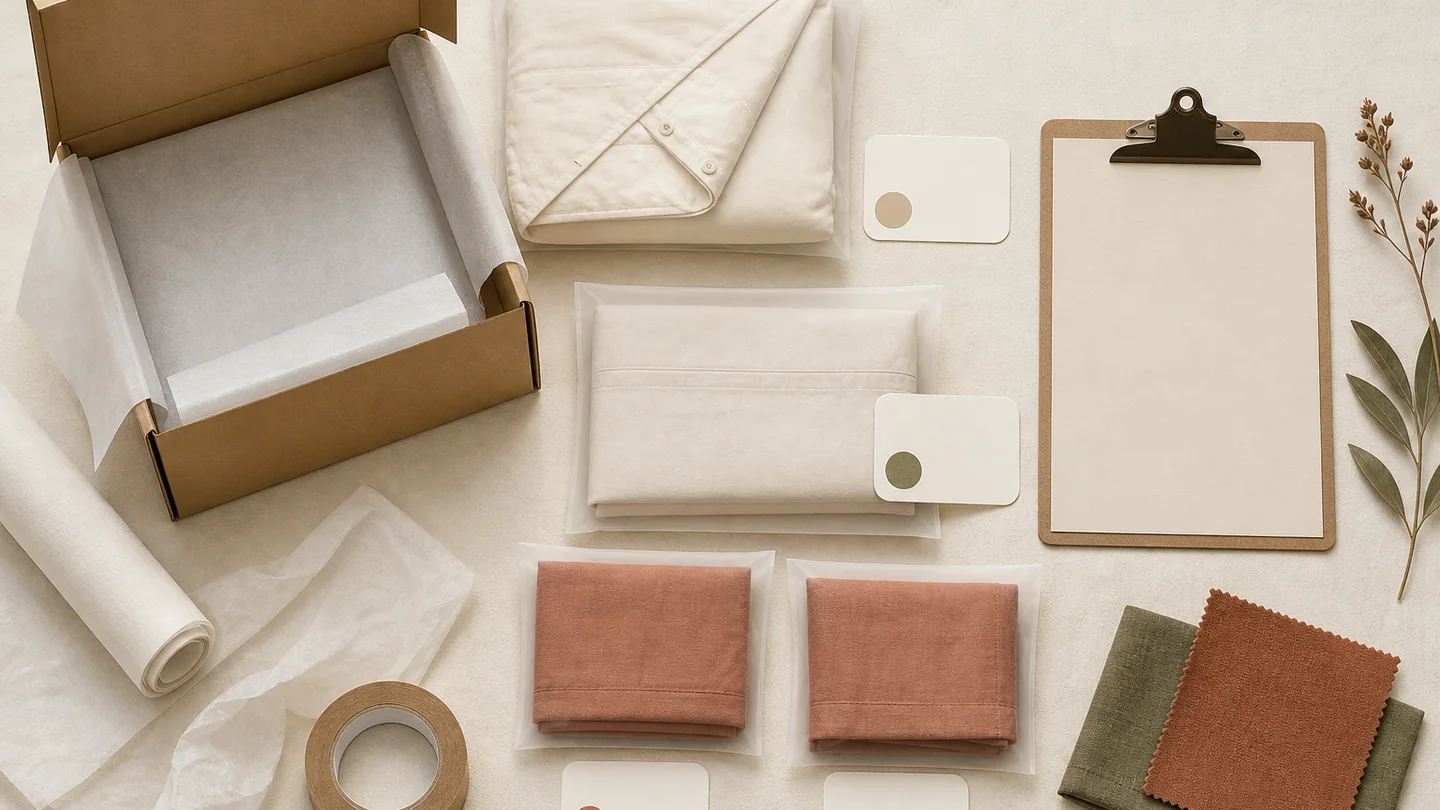
Towels can look almost identical in a tightly folded stack. Buyers still need to understand which size is shown, how the border is finished and whether the listing includes one towel or a complete set. A useful image sequence makes those distinctions clear before adding bathroom styling.
Old Money Visual photographs textiles, including towels, in Haimen, Nantong, China. Overseas buyers and China-based exporters can discuss photographs for listings, catalogs and buyer presentations while selected samples are in China. Confirm the sample inventory and scope before arranging delivery to the studio.
Build the sequence around product recognition
Start with the sale unit. A single bath towel, a matched hand-and-bath pair and a mixed-size bundle require different complete views. Keep styling props separate from included contents, and photograph the actual combination rather than building a visually attractive stack that changes the quantity.
| View | Purpose | Watch for |
|---|---|---|
| Open towel | Show shape, border placement and overall design. | Cropped edges that conceal the outline or decoration. |
| Folded towel | Show presentation and the visible pile. | Hidden padding or folds that exaggerate apparent thickness. |
| Terry close-up | Show loops and surface texture. | Over-sharpening, flattened pile or distracting loose lint. |
| Hem and border | Show stitching and woven or decorative details. | Retouching that removes real construction features. |
| Complete set | Identify every included piece. | Extra towels, misleading quantities or unclear size labels. |
| Color range | Connect each sample to its color code. | Mixed lighting and inconsistent folds across variants. |
Agree on sample condition before styling
Decide whether the photographs should represent towels as supplied or after a specified preparation step. Washing or other treatment can change the sample's appearance; obtain instructions instead of treating preparation as an invisible studio choice. Choose representative samples and disclose differences between them and the intended sale products.
For an embroidered towel, agree which physical face leads the listing and photograph the reverse when its visible finish matters to the buyer. A fold may show the logo correctly while hiding the back of the embroidery or a hanging loop. Identify those concealed areas in the shot request rather than asking an editor to mirror the logo onto another view. Keep the actual embroidery, hem and label orientation consistent between the open view and styled fold. A reverse detail can explain the supplied finish without implying that the towel has the same appearance on both sides.
- Label each sample with SKU, color, size and its place in a set.
- Provide a list of included pieces for every bundle being photographed.
- Flag embroidery, logos, hanging loops and labels that need dedicated views.
- Agree how lint, creases, loose threads and flattened pile should be handled.
- Supply approved dimensions and product claims separately for any graphics.
Verify the towel record before the first setup
Use one identity record for the physical sample, the shot list and the delivered filenames. This is especially important when the same color appears in several sizes or when one towel is photographed both individually and as part of a set. The record should state what was visible at arrival and which approved product data may be added to graphics.
Treat this as an image-verification step, not product testing. The studio can document the supplied sample and approved labels; it cannot infer absorbency, weight, durability or other performance from appearance.
| Verify | Required record | Image boundary |
|---|---|---|
| Sale unit and set relationship | State whether the SKU is one towel, a size variant or an included piece in a named set; list every included piece and quantity. | A complete-set image shows only the supplied combination and does not establish the contents of another SKU. |
| Open dimensions and profile | Provide approved length and width for the correct SKU and request a fully open view when outline or border placement matters. | The view shows the sample's visible shape; dimensions come from approved data, not estimates from perspective. |
| Border, hem and hanging loop | Mark the required face and note the position of woven borders, hems, embroidery, labels and any loop that must be visible. | Detail images document visible construction on the supplied sample without proving seam strength or wash durability. |
| Color code | Attach the buyer- or supplier-approved color code to each physical sample and keep it in the shot list and filenames. | The code identifies the photographed sample; a screen image is not physical color approval. |
| GSM | Supply GSM as approved product data tied to the SKU and source document when it must appear in a graphic. | GSM cannot be measured or inferred from a folded profile, pile close-up or apparent thickness. |
| Visible sample condition | Record lint, creases, pulled loops, loose threads, flattened pile and any approved preparation before styling. | The photographs can show the agreed visible condition after preparation, not absorbency, softness or performance test results. |
Make comparisons fair and claims supportable
For size comparisons, place the actual towels together with clear labels and a consistent viewpoint. Perspective can make the closer item appear larger, so do not use a styled arrangement as a dimensional diagram. If dimensions are overlaid, check them against approved specifications and match each label to the correct SKU.
Photographs can describe appearance; they cannot prove absorbency, fabric weight, fiber content, wash durability or antibacterial performance. A water demonstration is not a substitute for a test. Avoid editing ordinary pile into an unusually plush surface or describing a visually appealing towel as objectively softer without support.
Before delivery, check that filenames and the image list distinguish individual towels from bundles. Review every variant for accurate color labels, included quantities and visible details so a catalog editor can select the right image without guessing.
Assign responsibility for towel contents, labels and claims
A complete image set needs two separate approvals: one for what the photographs visibly show and one for the product information placed beside them. The studio can keep the supplied towel, label and filenames connected; it does not determine fiber content, care instructions, GSM, absorbency, durability or regulatory wording.
Before release, record who supplied each fact and who approved the exact combination of individual-towel and set images. If one towel appears both by itself and in a bundle, the manifest should identify which files may be reused and which sale-unit statements belong only to the set.
| Release question | Evidence needed | Responsible owner | Photography boundary |
|---|---|---|---|
| What is included? | SKU sheet listing every towel, size, color and quantity in the sale unit | Buyer or brand product owner | The image shows only the supplied combination prepared for camera |
| Which dimensions or GSM may appear? | Approved product data tied to the exact SKU and version | Buyer or brand product owner | Measurements and GSM are not inferred from folds, perspective or pile |
| Which label is current? | Label version, market or language designation and product mapping | Brand or its appointed reviewer | A readable photograph records the supplied label; it does not validate the statements |
| Which visible direction is approved? | Named proof files with the agreed fold, open view and detail views | Visual approver | Approval covers composition and visible presentation, not performance |
| Which files can be published? | Delivery manifest, set relationship and release status for each filename | Named publishing owner | Files remain on hold when the SKU, set contents or approved facts do not match |
Put this guide into a production plan
Confirm the actual scope from your samples, channels and accuracy requirements; these services are not automatically bundled.
Sources and further reading
These sources provide context for the claims or channel requirements discussed here. Review current requirements alongside your product information and project agreement.
- U.S. Federal Trade Commission: Threading Your Way Through the Labeling Requirements Under the Textile and Wool Acts ↗Official U.S. guidance used only to show that textile label statements need an appropriate product and market review. The brand supplies and approves label facts; photography does not prove compliance.
