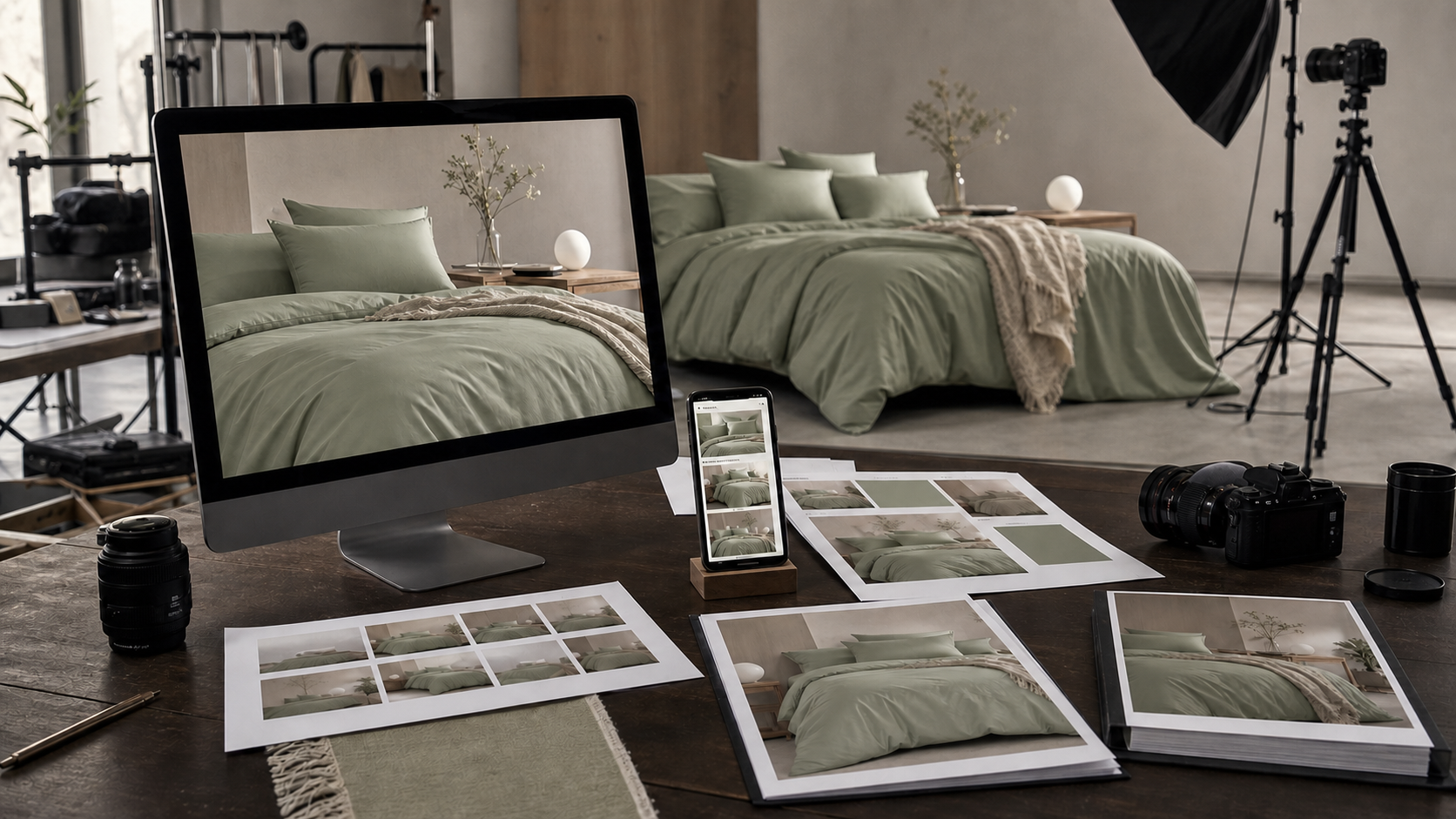
Plan the places you will use the images before shipping samples to the studio. Listings need product identification and detail; video needs movement; catalogs need consistent collections and space for layouts. Douyin and WeChat are additional China-market channels when relevant to your audience.
Begin with a list of master images and required outputs. A single landscape image will not necessarily survive every crop; some placements need a separate composition or video take.
Map each channel to the files it needs
Record the channel, placement, aspect ratio, image task, text space, need for motion and final export. This reveals incompatible requirements before the shoot.
A full product view, texture study or lifestyle scene may supply several channels. The underlying content can be shared even when the crop, sequence or final file must differ.
- Sales or content channel
- Page or content placement
- Aspect ratio
- Image task
- Space for text
- Still image or video
- Final export version
Keep product identification clear
A main listing image should remain understandable at thumbnail size. Detail images can then explain the setting, material, finish, included pieces and dimensions. The same set may serve both purposes through different shots.
Ask the brand to approve specifications and claims. The photographs provide the product views; layout and copy arrange the information without crowding every fact into a single image.
Plan movement and reading space for content
Short video needs a sequence, changes of view and framing suited to its placement. A slowly moving photograph does not replace footage showing handling or drape. Allow space for captions and human movement where needed.
For China-market WeChat articles or Channels, existing product views and clips may be useful, but headings, sequence and format still require a separate plan. Check the current requirements of each channel before publication.
Images for wholesale catalogs and buyer presentations
A wholesale buyer may compare several designs before placing an order. Plan a consistent master view for the range, then connect each image to its SKU, color reference and approved specification sheet. Keep decorative styling separate from the list of included pieces.
For a printed catalog or PDF presentation, agree layout dimensions and text space before the shoot. Confirm export requirements with the designer or printer. Photographs show the sample; they do not verify composition, performance, production capacity or stock availability.
Maintain a delivery manifest linking the master view, detail files and approved product record. For example, SKU001_COLOR01_MAIN_v01.jpg is an illustrative filename, not an actual client asset. Use the same identifiers on the sample label and review sheet.
| Buyer task | Image to plan | Information to link |
|---|---|---|
| Compare a collection | Consistent product view for each design | SKU, color and approved product name |
| Inspect construction | Weave, loop, seam or border close-up | Detail label and verified specification reference |
| Understand a set | All included pieces shown together | Piece count and size list supplied by the buyer |
| Prepare a catalog spread | Composition with agreed text space | Layout dimensions, crop and final file version |
Deliver traceable masters and exports
Keep a quality master and record each crop, text treatment and export. Use filenames that identify the SKU, color, image task and version so the source remains clear after revisions.
Review catalogs and collection pages as a group for color, scale and spread layout. A shared delivery list is easier to review than files scattered across different conversations.
Put this guide into a production plan
Confirm the actual scope from your samples, channels and accuracy requirements; these services are not automatically bundled.
Textile & Ecommerce Product Video
Show drape, texture, handling and product use through purposeful video planned for the channel.
Review the service scope →USE FOR · Collections, campaign directions and brand-owned channelsBrand Imagery & Creative Direction
Turn a collection theme into a practical direction for scenes, styling, light and key visuals.
Review the service scope →Sources and further reading
These sources provide context for the claims or channel requirements discussed here. Review current requirements alongside your product information and project agreement.
- MIIT: E-Commerce Law of the People's Republic of China ↗China-market context: Article 17 concerns accurate product information. Channel-specific edits should preserve the underlying product facts.
- Douyin Open Platform: Publishing Content to Douyin ↗Official documentation for China-market Douyin publishing capabilities and authorization. Review the current requirements before planning a publishing integration.